Franklin Templeton: Scalable webinars
We partnered with Franklin Templeton to launch a new webinar series for its Macro Moments thought leadership hub. The goal was to elevate the firm’s product expertise and showcase the voices behind the Franklin Templeton Institute, particularly global investment strategist Michael Browne.
Social teasers and promotion strategy
To build awareness and drive registrations, we created a suite of social-first assets, some fully animated, others featuring Michael Browne filmed at recognisable London landmarks. This mix allowed us to test performance across formats and platforms.
Speaker: Michael Browne - Global Investment Strategist for Franklin Templeton Institute
The US is a remarkable country.
Since 1945, it's been the world's largest economy through it's innovation and investment.
It seems that no one can catch them.
In this first episode of Macro Moments, we ask whether or not US exceptionalism can survive a more insular economy.
We ask: what does this mean for US assets, and whether or not the US dollar can continue to be the world's reserve currency.
Voiceover: Michael Browne - Global Investment Strategist for Franklin Templeton Institute
Oil prices up, Middle East conflict, US withdrawal, weak dollar, fiscal and current account deficits. Are we back in the 1970s?
Will the US economy lose its mojo? What does it mean for you?
Join me, Michael Browne and my guest, Professor Silvana Tenreyro, in the first episode of Macro Moments as we ask, can US exceptionalism continue or is it time for a change?
Webinar production strategy
This was also an exercise in production efficiency. Drawing on our live TV experience, we filmed four full-length webinars in a single day, using a tightly planned schedule, pre-scripted segments, and a studio setup optimised for speed.
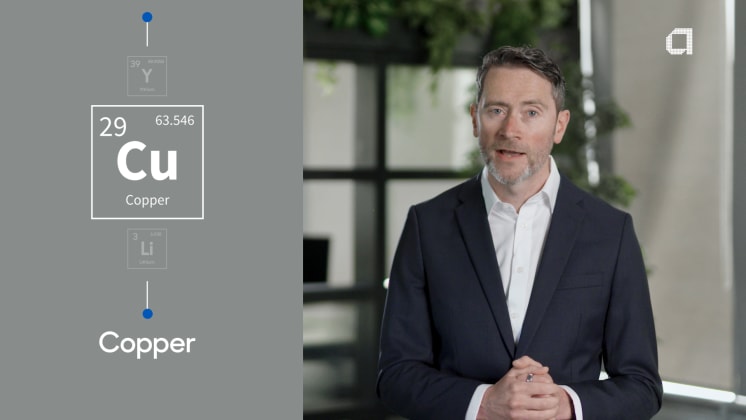
Each 45-minute episode was structured into three parts: The Macro, The Market, and The Managers. The “Managers” segment featured short-form stock stories—60-second explainer videos designed to prompt discussion and keep the format dynamic.
Voiceover:
India has become a global powerhouse.
By 2026 GDP growth is expected to hit 6.4%, cementing its place among the fastest-growing major economies.
Its banking sector is transforming, with active credit cards jumping from 57.7 million in 2020 to over 101 million in 2024
And there’s still significant room for growth.
India’s household debt to GDP ratio is still only around 39%, compared to 64% in China and 77% in the UK.
In this evolving financial landscape, ICICI Bank stands out - India’s second-largest private sector bank.
It supports all levels of the country’s transformation, from individuals looking to get on the housing ladder,
to large corporations driving sectors like renewable energy and healthcare.
It is also well placed to benefit from the rise in mobile banking, with significant expansion into digital services, and 30 million users of its payment app - iMobilePay.
As one of the largest banks
in the country, ICICI has an important role to play in providing access to the capital
that will unlock the next phase of India's remarkable growth story.
Final output
In addition to the full-length episodes, we also produced short animated teasers for each segment to support ongoing promotion across social channels.
Speakers: Michael Browne - Global Investment Strategist for Franklin Templeton Institute and Silvana Tenreyro - Economics Professor, LSE and Former BoE MPC Member
Michael Browne
You're not worried about the labour market being a source of inflation, sounds to me like you're rather optimistic?
Silvana Tenreyro
I am optimistic today about the UK. Inflation will get back to target in 2026. That will allow the Bank of England to lower rates.
I think the country is in the right trajectory trying to reduce the deficit and it's very determined to keep its openness to trade.
This is why I would be more optimistic about the UK today than perhaps the other side to the Atlantic.
Chris Simmers, Head of UK Digital Marketing, Franklin TempletonWorking with Sat and her team was an absolute pleasure. Their efficiency and attention to detail ensured that every aspect of the project ran smoothly, and they consistently delivered all our video content within agreed timelines and to a high quality.
Communication throughout the process was excellent, and they were incredibly responsive to our feedback and requirements